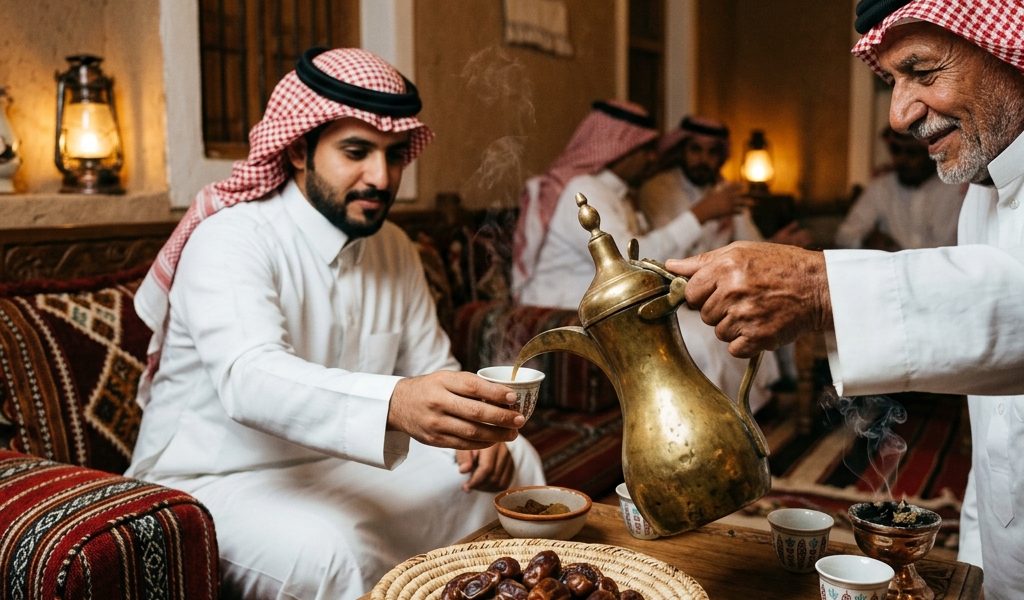

There is no seat in the majlis empty of meaning.
The majlis in a Saudi house is not a reception room. It is an institution: it has a seating order, a sequence for serving coffee, and rules for speech and silence.
The head and the door
The point furthest from the door is the sadr, the head, and there sits the eldest, the highest in standing, or the guest. Nearness to the door is the place of the youngest and of whoever serves. This order is never announced, and whoever enters knows it without being told.
Coffee as a clock
Serving coffee begins at the head and circles round. The number of cups and the way the cup is shaken are agreed signals. That is to say, a complete language runs through the majlis without words — precisely what anthropology calls codified non-verbal communication.
The majlis today
The furniture changed and the rule stayed. In many modern houses you find sofas instead of floor cushions, but the head is still the head. Which reminds us that culture holds on to structure and is lenient about form.
Republishing Anthro
Our work is free to republish under a Attribution — NoDerivatives licence. You may run it on your site or in print under the following terms:
- Publish the text as is, without altering its meaning or removing context.
- Credit the piece to its author and to Anthro, with a working link to the original.
- Images and illustrations are not included — each is separately licensed and must be cleared with its owner.
- Do not republish behind a paywall.