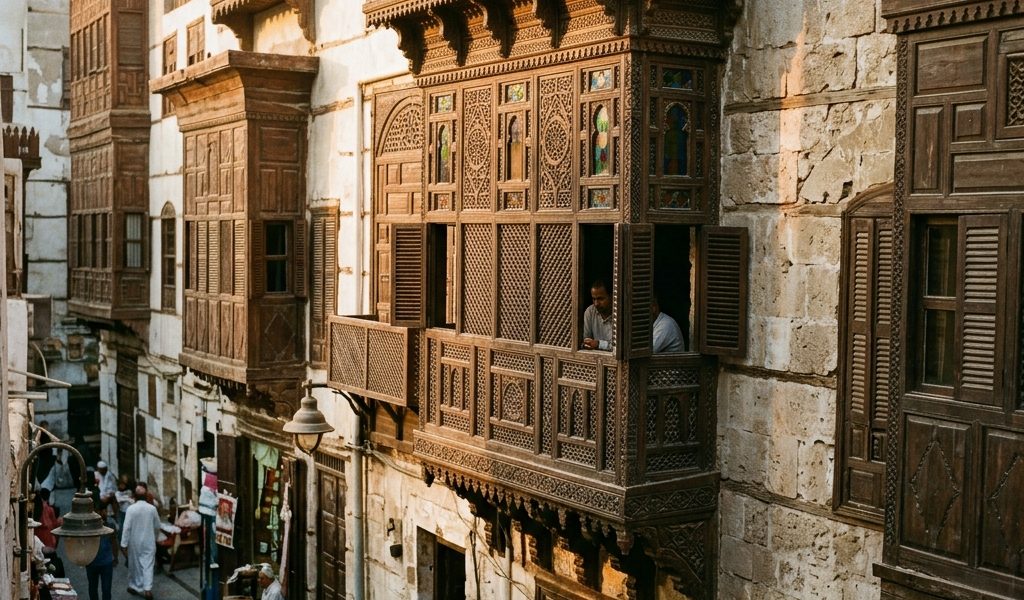

The rawshan is not a window but a philosophy — an architectural answer to an unending social equation between showing and hiding.
In old Jeddah, façades do not end at the wall. They extend outward through finely worked timber projections called the rawshan — those protruding windows that hold beauty and social function together at once.
Anthropologists describe the rawshan as a social façade rather than merely an architectural one. On one side it allows its owner to see without being seen; on the other it announces a presence without full exposure. That fine balance between disclosure and concealment reflects a deep Hijazi philosophy of managing social space.
The rawshan and the idea of hurma
In Hijazi tradition the notion of hurma — protection, inviolability — forms the backbone of social relations. In that frame the rawshan is not a piece of joinery but an architectural embodiment of the idea: it shields the household from the eyes of strangers while allowing it to take part in the public life of the street.
In her study Space and Gender in Islamic Architecture, the researcher Leila Ahmed notes that elements of this kind do not impose seclusion so much as negotiate presence, letting the household belong to public space without surrendering its privacy.
How the rawshan worked socially
Field interviews conducted in the Al-Mazloum quarter of Jeddah suggest the rawshan carried several social functions at once:
- watching the street and maintaining neighbourhood security;
- natural ventilation in a hot, humid coastal climate;
- declaring a family’s standing through the quality of the carving and the size of the rawshan;
- opening visual exchanges between women of neighbouring houses without breaching conventions on mixing.
What makes the rawshan anthropologically interesting is its capacity to hold real social tensions — between openness and enclosure, presence and absence, public and private — and to convert them into elegant material solutions.
A crisis of disappearance
With Jeddah’s rapid urban expansion, rawshan buildings erode by the day. Heritage authority figures indicate that 60% of the buildings in the old town need urgent restoration. But the more painful decay is not that of the timber; it is the decay of the social memory attached to it. When we lose the rawshan we lose not a piece of joinery but an entire social system for managing human contact in urban space.
Republishing Anthro
Our work is free to republish under a Attribution — NoDerivatives licence. You may run it on your site or in print under the following terms:
- Publish the text as is, without altering its meaning or removing context.
- Credit the piece to its author and to Anthro, with a working link to the original.
- Images and illustrations are not included — each is separately licensed and must be cleared with its owner.
- Do not republish behind a paywall.