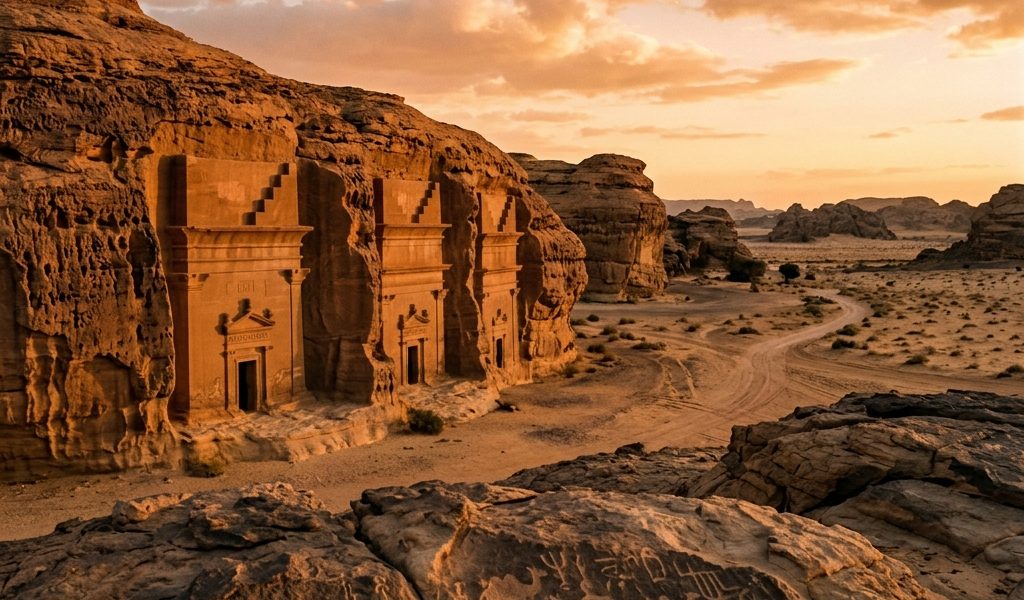

Carving on rock is not only art — it is the first cry of a human being who refused to pass without a trace.
Walking among the rocks of AlUla you are not walking through a museum — you are walking through a conversation. A human conversation accumulated over thousands of years, carved with patience, need and sometimes despair into the faces of red stone.
The Thamudic, Lihyanite and Nabataean inscriptions covering AlUla’s walls are more than archaeological data. They are the archive of the ordinary person: names their owners loved enough to want made permanent, prayers raised in moments of weakness, messages left by travellers for whoever came after.
Writing as an existential act
The philosopher Jacques Derrida saw writing as the trace above all — an insistence on existing in the face of vanishing. The desert inscriptions of AlUla embody that insistence in its most honest and simplest form. Most seek neither fame nor historical glory; they are content to say: I was here. I passed through. I loved. I was afraid.
Reading the margin
What makes these inscriptions anthropologically exceptional is that they let us hear voices official history never recorded: trade caravans, herders, passing visitors. This is history from below — made by ordinary people about whom the official registers say nothing.
In that sense the AlUla inscriptions redefine who holds the right to write history. Writing was not always an elite privilege; it was a deeper and older human need.
Republishing Anthro
Our work is free to republish under a Attribution — NoDerivatives licence. You may run it on your site or in print under the following terms:
- Publish the text as is, without altering its meaning or removing context.
- Credit the piece to its author and to Anthro, with a working link to the original.
- Images and illustrations are not included — each is separately licensed and must be cleared with its owner.
- Do not republish behind a paywall.