Is anthropology the study of primitive peoples?
A common question, and answering it exposes the history of the field and its critique of itself.
Human • Culture • Society • Living Memory
Field studies and critical readings of Saudi society: urbanism, kinship, the market, and memory.
38 piecesLong-form conversations with researchers, narrators and witnesses to change — in their voices, not ours.
9 episodeA guide to writing for a general reader, classroom-ready units, and a selection of poetry on place.
9 chaptersResearchers and academics writing anthropology in a language that reaches beyond the discipline.
5 contributorsA common question, and answering it exposes the history of the field and its critique of itself.
No questionnaires, no statistical samples. So what does a researcher actually do when they “go into the field”?
The old markets are still standing, but their customers have changed. What does it mean for a souq to become a destination?
A translation of an introductory piece on the anthropology of food, and why the table makes a good entry point for studying a society.
The cannon became a phone notification, and the shared iftar became a reservation. What is left of the rite?
What is not documented is forgotten, and what is forgotten is later reinvented in a form that does not resemble it.— from the Anthro editorial notebook
What is not said twice is forgotten once.
The first cup is for the guest, and the second for the sword,
Before identity papers, the wasm said whose camels these were and where their owner came from.
A monthly column written by a researcher from the field — this time from the alleys of a souq whose arrangement has not changed in decades.
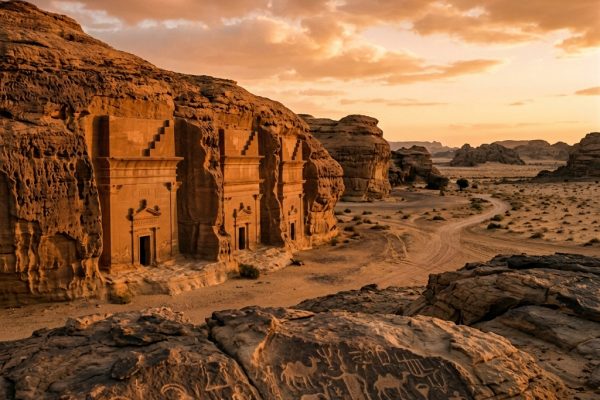
An anthropological analysis of rock texts and doctrinal symbols in the north-west of the Kingdom.
An anthropological reading of what coffee means, and of the rituals of serving it in Saudi society across generations.
We sit with those who know: a researcher just back from the field, a narrator who holds what was never written down, and a witness to a change they lived through and never read about.
A port city that lives on passage. How did that shape its architecture, its dialect and its relation to the newcomer?
Listen to this episodeClassroom-ready units, built from work published in Anthro.
A line, two lines, and a circle. He did not write his name,
Noura AlshamsiThey did not plant you for shade, they planted you so the ground would stay occupied.
Noura AlshamsiThe sellers fold away their voices as the mats are folded.
Khalid AlmuanenThey say: this is an old wall. And I say: this is a breath that stopped.
Sarah AlharbiShort answers written by specialists, for anyone approaching anthropology for the first time.
A practical guide for researchers who want their work to reach readers outside the field — from first idea to published article.
Subscribe to the Anthro weekly: one article, one story, one anthropological question each week.