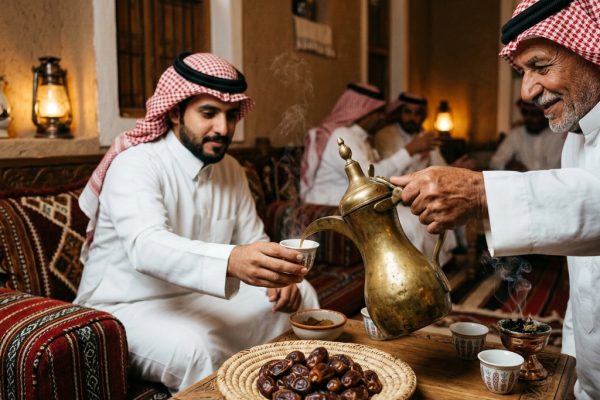
Saudi coffee: an anthropology of hospitality and social symbolism
An anthropological reading of what coffee means, and of the rituals of serving it in Saudi society across generations.
Reading the things we make and use as documents of identity and belonging.
An anthropological reading of what coffee means, and of the rituals of serving it in Saudi society across generations.
A line, two lines, and a circle. He did not write his name,
The trunk is a roof, the frond is rope and baskets, and the date is food, dowry and provision. The palm is not one tree.
The mortar, the quern and the roasting pan — tools read as documents about work, time and the division of roles.
Ornament in sadu is not decoration. It is a system of signs that people of the badia read the way writing is read.
The old souq in the Arab city is not only a place of buying and selling. It is a social theatre, a civilisational archive, and a map of identity drawn in people, smells and sounds.
The thobe and the ghutrah are not merely clothing. They are a daily performance of identity that declares belonging and negotiates presence in Saudi social space.
Subscribe to the Anthro weekly: one article, one story, one anthropological question each week.